CHILD POVERTY: AN URGENT PRIORITY
Child poverty affects hundreds of millions of children worldwide — here is why ending it must be at the center of global action.
AN URGENT PRIORITY
Ending poverty has become a defining goal for this generation, one that we all aspire to achieve and want to contribute to. But sadly, the reality is children remain disproportionally affected. Millions of children around the world remain poor, and deprived of what they need to develop and thrive.
We need to change this. We are calling on people and leaders around the world to take action to end child poverty as part of the SDGs.

CHILD POVERTY KEY FACTS
Poverty hits children hardest
Whilst poverty harms all human beings, it is more threatening to children. Childhood is a time of unique opportunity and vulnerability, and experiencing poverty in its various dimensions can be particularly damaging to a child’s development.
Children growing up in poverty are much more likely to die before their 5th birthday, and less likely to be well nourished, or receive a good education, basic healthcare or clean water and decent sanitation.
Poverty denies children of their right to grow up free from deprivation and want, and develop healthily to their full potential.
CHILDREN ARE MOST LIKELY TO BE POOR
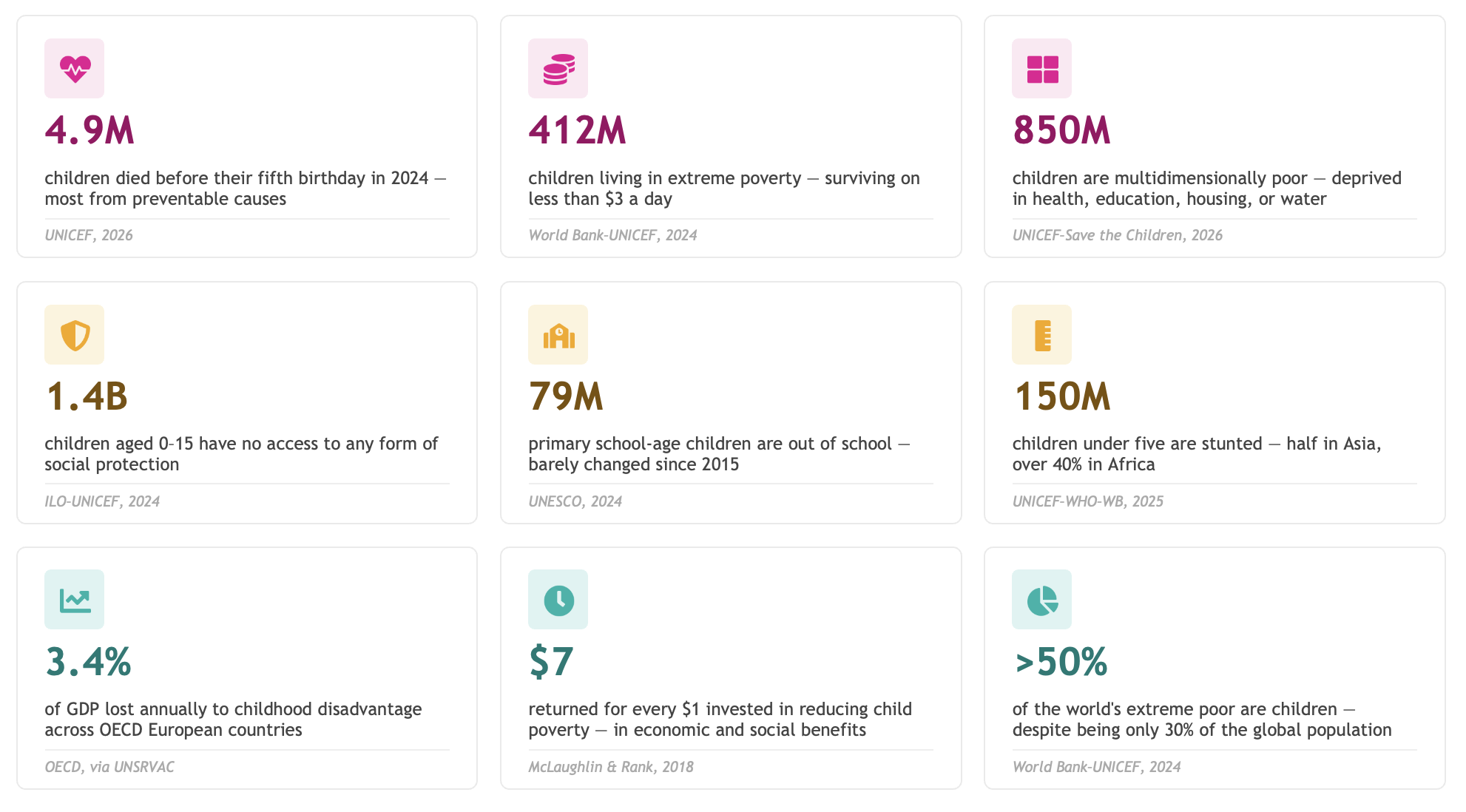
We know children are key to ending global poverty, and yet they remain disproportionally affected. Children make up more than half of all people living in extreme poverty, despite representing only about 30 percent of the global population.
Child poverty isn’t just a problem in poor countries. In every country with available data children are most likely to be poor. Even in the world’s richest countries, children remain disproportionally concentrated among the poor.
Child poverty is an issue that faces all societies, and must bind us, globally.
The cost of inaction
Ending child poverty is not only a moral imperative — it is an economic one. When children grow up in poverty, the consequences extend far beyond childhood. Poor nutrition stunts cognitive development. Interrupted schooling limits future earnings. Chronic ill-health drives up public expenditure for decades. These costs fall on individuals, families, and entire economies — and they compound across generations.
The evidence is unambiguous. According to the OECD, the economic cost of childhood socioeconomic disadvantage in European countries amounts, on average, to the equivalent of 3.4 percent of GDP annually. A landmark study estimated that child poverty costs the US economy just over $1 trillion per year, equivalent to 5.4 percent of GDP, through lost productivity and spending related to crime, health care, child welfare, and homelessness — and that for every dollar invested in reducing child poverty, societies gain back an estimated $7 in economic and social benefits.
If no corrective action is taken, according to UNESCO, by 2030 the annual cost to society of children who leave school early will reach US$6 trillion, while the cost of children lacking minimum basic skills will reach US$10 trillion — together exceeding the combined GDP of France and Japan.
The question is not whether we can afford to act. It is whether we can afford not to.
Put children first
The good news is that we have already made progress. Between 2014 and 2024, the number of children in extreme monetary poverty fell by approximately 95 million — from 507 million to 412 million. We have made crucial progress in reducing child malnutrition, expanding education, and providing many children with basic health care, safe drinking water, and basic sanitation.
But this is not enough. Many children continue to be born and grow up in poverty in its different dimensions, whilst alarming disparities persist, with the poorest children furthest behind. And progress is fragile: compounding crises — from conflict and climate change to rising debt burdens — are threatening to reverse the gains made.
We need to change this. Lifting children out of poverty will make a huge difference to their lives, and those of the families, communities, and countries in which they live.
Support the fight to end child poverty
We all have a role to play, please spread the word to help #ENDchildpoverty in all its forms