
Addressing Child Poverty
How can we address child poverty?
While there are many important nuances in what causes poverty in different countries and communities, there are common threads and proven solutions that work almost universally. What that looks like in practice comes down to a few consistent elements:
Lasting change requires countries to make ending child poverty a national priority. This means child poverty must be explicitly reflected in national budgets, policies, and laws. Achieving this requires not only government leadership but also meaningful engagement with adults and children living in poverty, civil society, community leaders, implementing agencies, trade unions, and many other stakeholders.
Routine measurement and monitoring are key to tackling child poverty. Measuring child poverty helps us better understand the issues and identify children at greatest risk. It also supports evaluation of policy impact, improves resource allocation, and strengthens accountability.
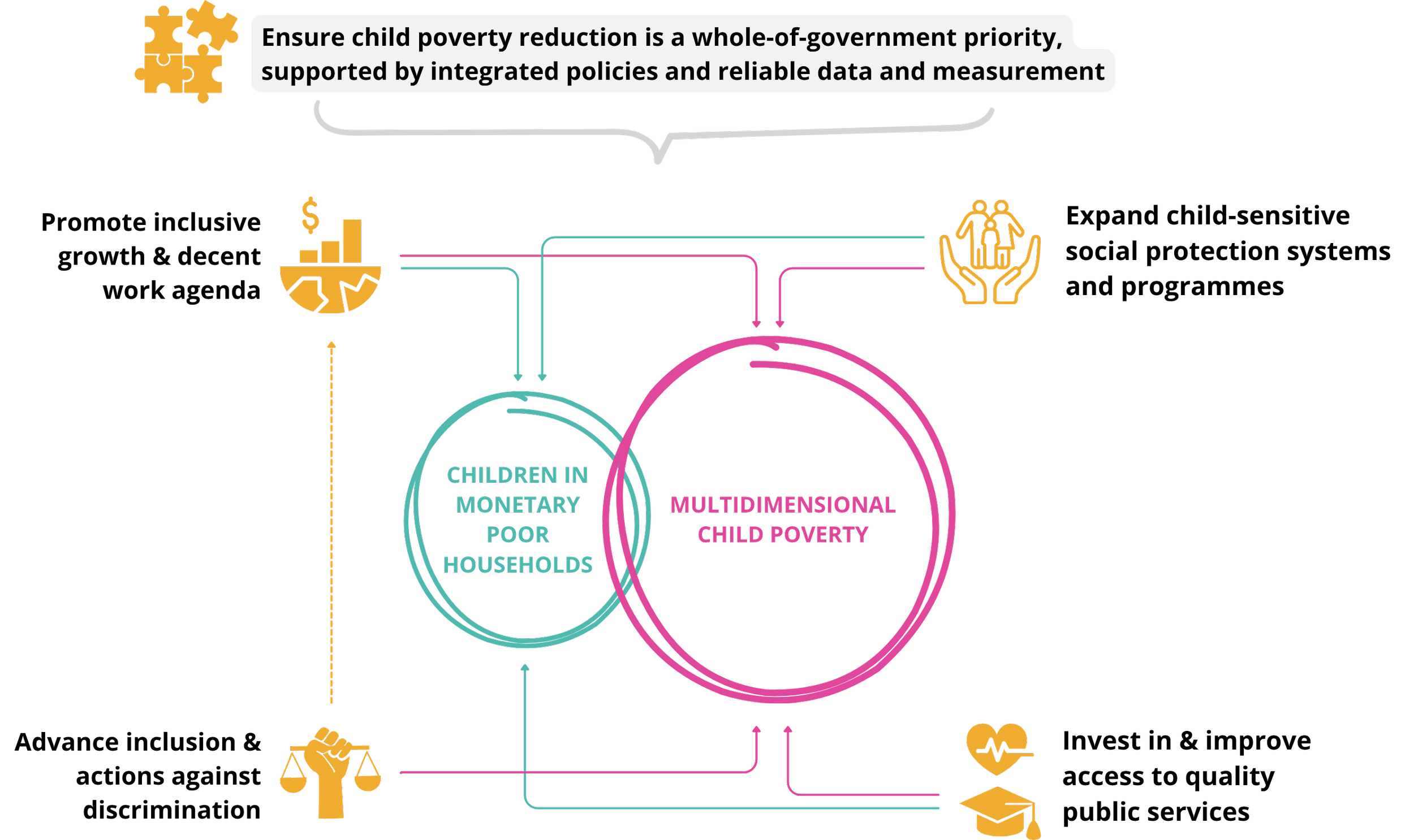
Decades of efforts to end child poverty have produced a range of impactful policies and programmes with proven, lasting results for children.In our 2025 report What Works to Reduce Child Poverty? Insights from Across the Globe, we identify five key strategies:
Promote a decent work and inclusive growth agenda to reach families and children living in poverty.
Expand child-sensitive social protection systems and programmes.
Improve access to quality public services, especially for the poorest children.
Advance inclusion and action against discrimination.
Make child poverty a whole-of-government priority, integrating policies across sectors.
Where can I Find more information about proven solutions to reduce CHild poverty?
You can learn more about effective policy approaches to addressing child poverty here:
What works to reduce child poverty? Insights from across the globe (Global Coalition to End Child Poverty, 2025)
The State of the World’s Children 2025: Ending Child Poverty - Our shared imperative (UNICEF, 2025)
Ending Child Poverty: A policy agenda (Global Coalition to End Child Poverty, 2022)
A World Free from Child Poverty (Global Coalition to End Child Poverty & UNICEF, 2017)
What are the Sustainable Development Goals, and how do they address child poverty?
The 2030 Agenda for Sustainable Development, adopted by all United Nations Member States in 2015, provides a shared blueprint for peace and prosperity for people and the planet, now and into the future. At its heart are the 17 Sustainable Development Goals (SDGs), which are an urgent call for action by all countries in a global partnership. Goal 1 focuses on reducing poverty in all its forms everywhere, which includes children in its targets and indicators.
Target 1.2 focuses on reducing at least by half the proportion of men, women and children of all ages living in poverty in all its dimensions according to national definitions, with indicators such as the proportion of the population living below the national poverty line disaggregated by age.
Target 1.3 asks countries to track the percentage of the population covered by social protection floors/systems, distinguishing children.
This global mandate requires member states to report on progress on reducing the poverty of children and creates an opportunity for stakeholders engaged in the fight against child poverty to engage in national processes to achieve this goal.
For the first time, there is an explicit commitment that all countries measure all dimensions of child poverty and strengthen policies and programs, including child-sensitive social protection, to meet the child poverty reduction goal by 2030. Therefore, the SDGs offer a tremendous opportunity for countries to take action and respond to child poverty. The Global Coalition to End Child Poverty have produced a comprehensive guide that collects experiences and approaches from around the world to support policymakers, practitioners and advocates, as they work towards achieving the SDG child poverty targets.

What are countries doing to achieve the SDG targets on child poverty?
The SDG Agenda provides a clear framework for action: Countries must eradicate extreme child poverty by 2030 and halve the number of children living in poverty in all its forms according to national definitions. One way to gauge progress on SDG implementation is to survey the data and the narrative content that countries present in their Voluntary National Reviews (VNRs). The Coalition assessed VNRs from a child poverty perspective, looking at how countries mention and discuss their efforts to end child poverty, through measurement and policies:
Monetary Child Poverty: SDG indicator 1.2.1 specifies the reporting of the proportion of the population living below the national poverty line, and this should be disaggregated by age, recognizing children as a distinct category. In 2020, while all 45 reviews discussed poverty eradication, only 11 reviews explicitly point out the monetary poverty rate for children, compared to 17 out of 46 in 2019.
Multidimensional Child Poverty: Income alone is not sufficient to assess the multiple and overlapping deprivations children face in their daily lives, affecting, for example, their health, education, and living standards. 9 out of 45 countries reported multidimensional poverty data on children in 2020, corresponding with the SDG target 1.2.2 – “reduce at least by half the proportion of men, women, and children of all ages living in poverty in all its dimensions according to national definitions”.
Policies and programmes to address child poverty: SDG targets 1.3 and 1.4 highlight the importance of social protection systems and floors and improved access of the poor to essential public services. In 2020, among the 45 countries who submitted their VNRs, 33 mentioned their efforts to tackle child poverty through various policy and sector-specific actions.
The Global Coalition to End Child Poverty brings together governments, civil society organizations, UN agencies, and other stakeholders committed to making child poverty a thing of the past. Through knowledge generation, advocacy, and coordination across its global membership, the Coalition supports countries to translate commitment into action. Explore our resources, engage with our work, and join the growing movement of organizations and individuals working toward a world where every child can thrive.