
Tracing the consequences of child poverty
Book
The study uses 15 years of #longitudinal data from Ethiopia, India, Peru and Vietnam to recommend policies to support disadvantaged children.
Using life course analysis from the Young Lives study of 12,000 children growing up in Ethiopia, India, Peru and Vietnam over the past 15 years, this book draws on evidence on two cohorts of children, aged from 1 to 15 and from 8 to 22.
It examines how poverty affects children’s development in low and middle income countries, and how policy has been used to improve their lives, then goes on to show when key developmental differences occur.
It uses new evidence to develop a framework of what matters most and when and outlines effective policy approaches to inform the no-one left behind Sustainable Development Goal agenda.

Child Sensitive Graduation Programming
Graduation programmes consist of targeting poor households with a combination of layered and sequenced interventions, often over a defined period of time, in order to facilitate the achievement of strengthened and sustainable livelihoods.
GUIDANCE BRIEF
Child Sensitive Graduation Programming: A Guidance Brief for Country Offices
Graduation programmes consist of targeting poor households with a combination of layered and sequenced interventions, often over a defined period of time, in order to facilitate the achievement of strengthened and sustainable livelihoods.
To ‘graduate’, a household needs to meet a criteria that indicate their livelihood strategies can secure a level of income sustainably, in addition to meeting a set of conditions that will protect their livelihoods from stresses that could result in a slippage back into poverty.
This guidance paper provides an overview of Graduation Programming for Country Offices, including;
Definitions and outcomes
Examples from Save the Children programming
Technical components
Measuring outcomes
Ensuring child sensitivity

The African Report on Child Well-Being 2018
The 2018 edition scores and ranks the performance of 52 African governments in improving the well-being of children. The report uses a robust, rights-based statistical methodology – the Child-Friendliness Index – and a wide range of data to measure and track progress in the commitment of African governments to children.
Report
Progress in the Child-Friendliness of African Governments
The 2018 edition scores and ranks the performance of 52 African governments in improving the wellbeing of children. The report uses a robust, rights-based statistical methodology – the Child-Friendliness Index – and a wide range of data to measure and track progress in the commitment of African governments to children.


Poor Children in Rich Countries
Policy Brief
This policy brief highlights the current state of child poverty in OECD countries and why we need policy action.
POLICY BRIEF
WHY WE NEED POLICY ACTION
Childhood is a critical period for the development of human and social capital of individuals. However far too many children do not get the best possible start in life due to poverty during their early years. Child poverty is not a new policy issue, but it has received renewed attention with the adoption of the Sustainable Development Goals. This policy brief highlights the current state of child poverty in OECD countries and why we need policy action.
Key messages;
On average across the OECD, almost one in seven lives in income poverty.
Child poverty rates increased in almost two thirds of OECD countries following the Great Recession 2007/08
In many countries the breadth and depth of poverty has increased in recent years
Stable, full-time parental employment is central to efforts to protect children from poverty
Promoting work among low-income parents requires strengthened support for affordable childcare services. Moreover parents from poorest families often face multiple obstacles to their return to work which requires appropriate and intensive assistance
A budget neutral redistribution of family and housing benefits to poor families can help reduce child poverty


Conditionality in cash transfers: UNICEF’s approach
Brief
The issue of conditionality has generated substantial debate in cash transfer policy and design. This brief summarizes the debate, practice and evidence around conditional and unconditional cash transfers, before outlining UNICEF’s approach.
Brief
Summary on the debate, practice and evidence around conditional and unconditional cash transfers
Conditional cash transfers are transfers given to beneficiaries conditional on specific actions such as sending children to school or making regular health visits, and unconditional transfers are those that are given to beneficiaries without any specific requirements beyond eligibility.
Conditionality is also sometimes referred to as co-responsibilities, particularly in Latin America. Conditionality is not the same thing as eligibility or enrolment criteria, such as poverty-related criteria or possession of identification documents.
The issue of conditionality has generated substantial debate in cash transfer policy and design. This brief summarizes the debate, practice and evidence around conditional and unconditional cash transfers, before outlining UNICEF’s approach.

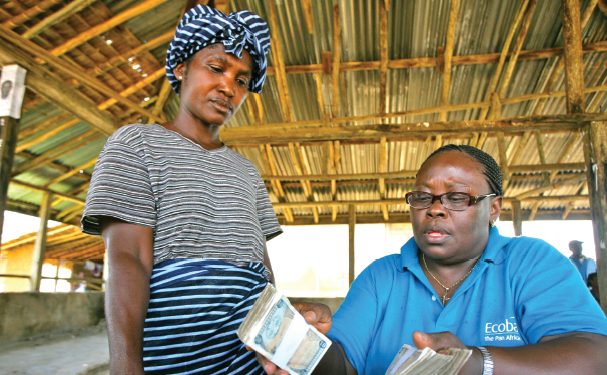
Addressing the Myths: The affordability of social protection
Brief
This brief summarizes the major considerations and available evidence around the issue of affordability, and highlights some available financing options that countries have used in introducing and scaling up social protection programmes.
Brief
Summary on the major considerations and evidence around the affordability of social protection programs
The need to increase coverage of social protection is great: around 5 billion people - 73 per cent of the world’s population - still live without adequate income security and/or access to social protection and about 870 million people in extreme poverty remain uncovered.
Given the proven impacts of social protection this lack of coverage can have very significant negative implications for child outcomes and development. However, concerns about the affordability of social protection programs - and the long run financial obligations they create, can present major challenges in expanding access to cash transfers and other social protection services.
This brief summarizes the major considerations and available evidence around the issue of affordability, and highlights some available financing options that countries have used in introducing and scaling up social protection programmes.


Addressing the Myths: Do social protection programs lead to misuse and dependency?
Brief
A common misunderstanding is that cash transfers are misused and lead beneficiaries to become dependent on “handouts”. This policy brief draws on existing evidence to analyse this concern about social assistance and its propensity to induce dependency and misuse.
Brief
Evidence summary on dependency and misuse of cash transfers
Currently, one billion people in developing countries participate in at least one social assistance program that provides support to low income individuals and households. These programmes are proven to have positive impacts on a range of outcomes from reducing food insecurity, poverty and vulnerability to specific child related outcomes such as schooling, health and nutrition among many others.
However, despite the proliferation of these programs across the world, they are often criticized on the grounds that they lead to participants becoming dependent on the programmes without providing incentives to work or finding work.
An associated assumption is that if poor people are given social assistance - particularly cash transfers - they will ‘waste’ it on demeritorious goods. While in any large programme there may be individual cases leading to anecdotal examples to support these concerns, it’s important to view them in light of the overall empirical evidence of the programmes. This policy brief draws on existing evidence to analyse these concerns about social assistance and its propensity to induce dependency and misuse.
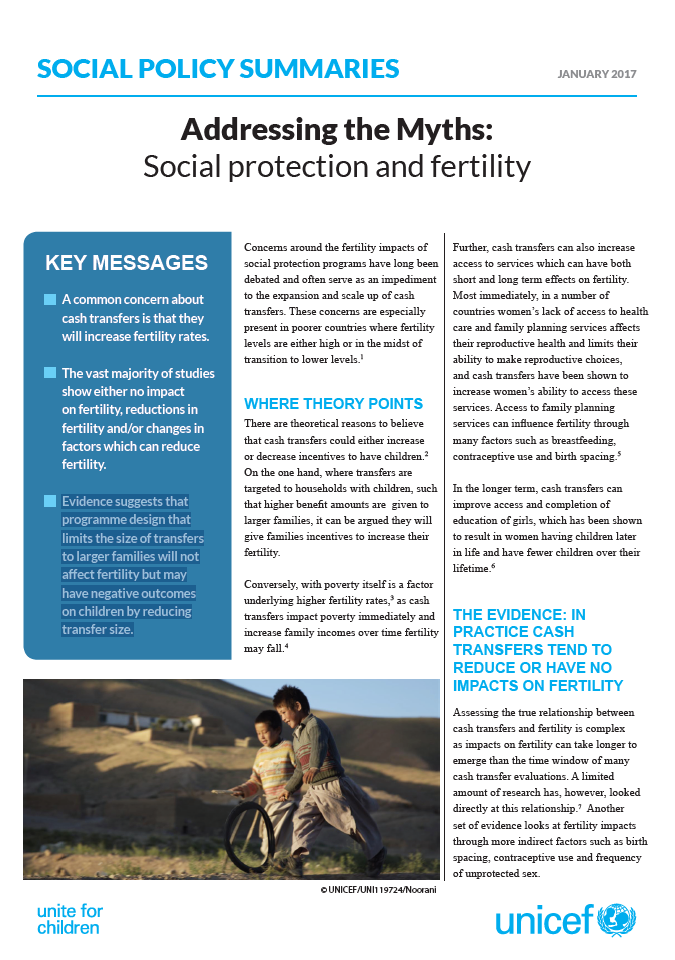
Addressing the Myths: Social protection and fertility
Brief
Concerns around the fertility impacts of social protection programs have long been debated and often serve as an impediment to the expansion and scale up of cash transfers. This brief summarizes the theory and evidence on the debate.
Brief
Theory and evidence summary on impact of social protection on fertility
Concerns around the fertility impacts of social protection programs have long been debated and often serve as an impediment to the expansion and scale up of cash transfers. These concerns are especially present in poorer countries where fertility levels are either high or in the midst of transition to lower levels.
The vast majority of studies show either no impact on fertility, reductions in fertility and/or changes in factors which can reduce fertility. Evidence suggests that programme design that limits the size of transfers to larger families will not affect fertility but may have negative outcomes on children by reducing transfer size.

Making Cash Transfers Work for Children and Families
Report
2018 UNICEF report providing an overview of why cash transfers matter for children and families, how UNICEF has engaged with cash transfers globally and what opportunities and challenges exist.
Report
Guide to the introduction, expansion and improvement of cash transfers for children and families
UNICEF’s work on social protection has increased rapidly over the last decade. Among social protection interventions, cash transfers are one of the most common components supported by UNICEF, reaching over 70 countries in 2015. Depending on country contexts, the types of activities UNICEF engages in vary greatly – from modelling how cash transfers could work through a pilot programme, to conducting impact evaluations and policy engagement with decision makers.
The first part of this document gives a brief background of why cash transfers matter for children, how UNICEF has engaged with cash transfers globally and what opportunities and challenges exist. The second part outlines a cycle of four broad areas where UNICEF works:
Taking stock: analysis of child poverty and existing cash transfer programmes;
Setting the direction: examining programme design options;
Mobilizing support and resources: policy engagement and advocacy;
Achieving results on the ground: implementation with monitoring and evaluation.
Under these areas, this document seeks to give a range of options and activities to improve the lives of children and families. It investigates 19 concrete activities undertaken by UNICEF Country Offices that could contribute to the introduction, expansion and improvement of cash transfers. For each activity, the document describes potential approaches and considerations, along with country examples and links to key resources which provide more detailed guidance and information about each aspect of the work.


Still Left Behind?
Report
Tracking children's progress against the pledge to Leave No One Behind, Save the Children is calling for governments and international agencies to track not just national and global average progress, but also the pace at which disparities between socioeconomic groups are narrowing.
Report
Tracking children's progress against the pledge to Leave No One Behind
Governments around the world are failing to honour a pledge to reduce extreme inequalities in child survival, malnutrition, education, protection and other development indicators. In 2015, world leaders signed up to the United Nations Sustainable Development Goals (SDGs) – a set of 2030 targets for eradicating extreme poverty in all its forms. As part of this agreement, governments committed to ensure that the pace of change would be fastest for those left furthest behind. Evidence set out in Save the Children’s 2018 report shows that progress to date has been limited, and that SDG monitoring and review is still focusing on average change rather than those who are furthest behind. This neglect of unfair inequalities threatens to derail the entire SDG project.
To illustrate this globally, this report presents inequality trends for five key child poverty indicators – child mortality, malnutrition, child marriage, birth registration and primary education. Across all of the indicators analysed, it was found that inequality is a major barrier to progress, with the world’s poorest households lagging considerably behind global average rates of change.
Save the Children is therefore calling for governments and international agencies to track not just national and global average progress, but also the pace at which disparities between socioeconomic groups are narrowing.


Child Monetary Poverty and Multidimensional Deprivations
Academic Article
Co-authored by PEP’s John Cockburn, this paper analyses the causal effect of parental education on the potential mismatch between child monetary poverty and multidimensional deprivations.
Academic Article
Child Monetary Poverty and Multidimensional Deprivations: Why they Differ
Article co-authored by Partnership for Economic Policy's (PEP) scientific adviser John Cockburn
Abstract:
"We analyse the causal effect of parental education on the potential mismatch between child monetary poverty and multidimensional deprivations. First, in a simple model of parental investment in child outcomes, we demonstrate that the misalignment between household monetary resources and parental education causes a mismatch. Indeed, a match between poverty and deprivation occurs whenever household consumption expenditure and parental education are correlated. Second, using micro-level data from Tanzania, we find that parental education has a negative effect on the probability that a monetarily non-poor child suffers some basic deprivations, and a positive effect on the likelihood that a monetarily poor child suffers no basic deprivations".
Publisher: Oxford University Press on behalf of the Centre for the Study of African Economies
Publication date: 12th March 2018
Access Article (Subscription required)

The Many Faces of Exclusion: End of Childhood Report 2018
REPORT
1.2 billion children are threatened by conflict, widespread poverty or discrimination against girls.
In commemoration of International Children’s Day, Save the Children released its second annual End of Childhood Index, taking a hard look at the events that rob children of their childhoods and prevent them from reaching their full potential.
REPORT
1.2 billion children are threatened by conflict, widespread poverty or discrimination against girls
In commemoration of International Children’s Day, Save the Children released its second annual End of Childhood Index, taking a hard look at the events that rob children of their childhoods and prevent them from reaching their full potential.
Compared to last year, the index finds the overall situation for children appears more favorable in 95 of 175 countries. This is good news – it shows that investments and policies are working to lift up many of our children. But the index also shows progress is not happening fast enough, and conditions appear considerably worse in about 40 countries. Lost childhoods are increasingly concentrated among the poorest children and children affected by conflict. These conditions tend to exacerbate gender bias and increase negative experiences that end childhood for girls.
This year, the greatest threats to the 1.2 billion at-risk children are listed as:
- Poverty – Affecting 1 billion children living in poverty-ridden countries.
- Conflict and Fragility – Affecting 240 million children living in conflict-affected or fragile states
- Discrimination against Girls – Affecting 575 million girls in countries characterized by gender discrimination


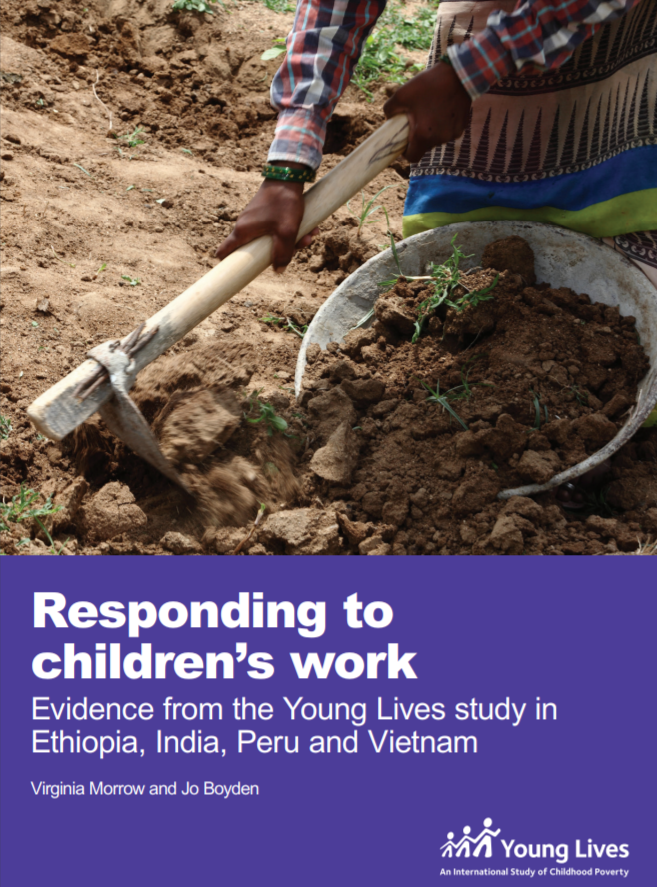
Responding to Children's Work
REPORT
Young Lives summative report, synthesising research from the past 15 years on children's work. The report highlights key principles for child-sensitive programming that will help minimise the risk of burdensome work for children, while maximising children’s well-being.
Report
Evidence from the Young Lives study in Ethiopia, India, Peru and Vietnam
Young Lives summative report, synthesising research from the past 15 years on children's work. The report highlights key principles for child-sensitive programming that will help minimise the risk of burdensome work for children, while maximising children’s wellbeing – always acting in the best interests of children.
Focus on the most harmful work – National and global efforts should aim to eliminate the worst forms of work. Target 8.7 of the Sustainable Development Goals and the ILO Convention 182 on the Worst Forms of Child Labour provides a framework for this, protecting children at the greatest risk of harm while recognising that not all work is harmful. Some forms of work can be beneficial to children including teaching them necessary skills for the future.
Child labour legislation needs to be implemented sensitively – Governments should engage with communities and families so that children who work and their families are neither stigmatised nor penalised. Rather than simply imposing solutions, it is important to talk with children and families about the pressures on their lives and evaluate the impacts of potential interventions.
Address family poverty – Child-sensitive social protection should be expanded to better support children and their families living in poverty and reduce their reliance on children’s work.
Help children who work to access schooling that is fit for purpose – Authorities should support the education of those children who need to work. This means ensuring that education is more beneficial and attractive by improving the quality and flexibility of schooling, as well as making schools safer by addressing corporal punishment and bullying.
Address care work in the home – Prioritise interventions which aim to reduce pressures associated with care work within households, such as improved access to childcare or decreased domestic work, so relieving the burden most often experienced by girls.

Children's Experience of Violence
REPORT
Young Lives' key findings on violence affecting children, exploring what children say about violence, how it affects them, and the key themes that emerge from a systematic analysis of the children's accounts from studies in Ethiopia, India, Peru and Vietnam.
Report
Evidence from the Young Lives study in Ethiopia, India, Peru and Vietnam
Globally, increasing efforts in policy, programming and advocacy are focused on eliminating all forms of violence against children. While children are central to these initiatives, we rarely hear the views of those most affected, children themselves. In this summative report, Kirrily Pells and Ginny Morrow highlight Young Lives' key findings on violence affecting children, exploring what children say about violence, how it affects them, and the key themes that emerge from a systematic analysis of the children's accounts from our study countries of Ethiopia, India, Peru and Vietnam.


Access to Primary School Education
ATD Fourth World Participatory research carried out in the Kinondoni district of Tanzania to understand the ideal living conditions for children living in extreme poverty to start and finish their primary school cycle.
Report
Access to Primary School Education for Children Living in Extreme Poverty
Primary school education is one of the building blocks of life; a child’s right to primary school education is non-negotiable, regardless of the child’s wider family economic, cultural or social background. Between January 2015 to March 2016, a participatory research was carried out in the Kinondoni district of Tanzania by a research team of diverse stakeholders - individuals with a direct experience of extreme poverty, teachers, students, local leaders and ATD Fourth World volunteers - to understand the ideal living conditions for children living in extreme poverty to start and finish their primary school cycle.
The intent of the research and publication of this report was to:
- better understand how the health, income, and wider community relationships have an impact on a child’s primary school education: the primary school education of children from extremely poor families is indeed rooted in a much larger context of their immediate and extended families, and wider community. A more holistic approach encompassing housing, community, work, income, health, and school is needed to understand how children can better succeed at school.
- gather the findings to make conclusions and recommendations for teachers and other educational stakeholders, parents, and local and national governments encouraging them to work together and take interconnected commitments to ensure children successfully start and finish their primary school education.


Monetary and Multidmensional Child Poverty
Although the multidimensional nature of poverty is widely recognized, the extent to which monetary measures can serve as a proxy for non-monetary measures remains unresolved. New Research from Keetie Roelen of IDS explores the issue and highlights implications for policy and future research.
RESEARCH ARTICLE
Monetary and Multidimensional Child Poverty: A Contradiction in Terms?
Although the multidimensional nature of poverty is widely recognized, the extent to which monetary measures can serve as a proxy for non-monetary measures remains unresolved. This is of particular concern for children given their dependence on others for fulfilment of basic needs and assumptions about intra-household distribution that underpin monetary measures. This article adopts an innovative mixed-methods approach to investigate child poverty overlap and mismatch in the low- and middle-income countries of Ethiopia and Vietnam using secondary longitudinal survey data and primary qualitative data from adults and children. Findings indicate that monetary and multidimensional poverty are distinct constructs that are linked, but cannot serve as a proxy for one another. While the degree of dissonance depends on the types of indicators under consideration, poverty mismatch persists regardless of time, place and multidimensional measure under consideration.

Author/s: Keetie Roelen
Published By: Development and Change (Journal) Volume 48, Issue 3
May 2017
Article available here

How Families Cope With Poverty In Asia
REPORT
In order to understand better the food security and livelihoods challenges in Asia, and how these relate to undernutrition and broader child wellbeing, Save the Children has conducted a retrospective synthesis review of its analyses in the region. This review draws on the data, findings and recommendations from 15 studies carried out in five countries in Asia – Bangladesh, Myanmar, Nepal, Pakistan and the Philippines – between 2011 and 2015.
REPORT
Lessons from a multi-country review of Household Economy Analysis and Cost of the Diet Assessments, 2011-15
In order to understand better the food security and livelihoods challenges in Asia, and how these relate to undernutrition and broader child wellbeing, Save the Children has conducted a retrospective synthesis review of its analyses in the region. This review draws on the data, findings and recommendations from 15 studies carried out in five countries in Asia – Bangladesh, Myanmar, Nepal, Pakistan and the Philippines – between 2011 and 2015.
How Families Cope with Poverty in Asia aims to improve understanding of:
- what drives household poverty and food insecurity in Asia, and
- how the poorest households – and children, in particular – are affected by poverty and food insecurity.
This review is intended primarily for economic strengthening and nutrition practitioners and policy-makers in the region, and includes recommendations for programming.

Authors: Vanessa Self / Rachel Childs / Laura Swift
Publisher: Save the Children
Publication Year: 2017
Download the report here

Tackling Child Poverty in Latin America: Rights and Social Protection in Unequal Societies
BOOK
This book highlights current debates about concepts, methods, and policies related to poverty in Latin America. It focuses on child and adolescent well-being and the issue of inclusive societies. Its goal is to promote new and critical thinking about these issues globally and in Latin America.
BOOK
This new book highlights current debates about concepts, methods, and policies related to poverty in Latin America. It focuses on child and adolescent well-being and the issue of inclusive societies. Its goal is to promote new and critical thinking about these issues globally and in Latin America.
The authors emphasize the need to develop new conceptual and practical avenues that can address the issues of poverty, marginalization, exclusion, and old and new inequalities in post-neoliberal times. The objective is to advance the rights of all children and adolescents in the region.
This urgent book represents a unique opportunity for practitioners, policy makers, researchers, and students to get access to the most up-to-date perspectives on child poverty and inequality from a conceptual and practical point of view.
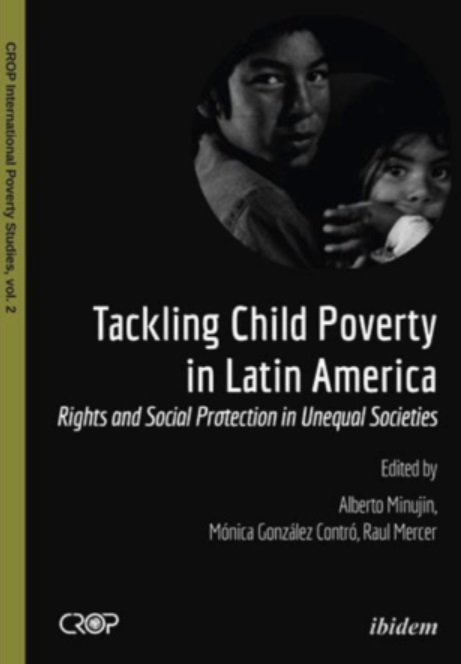
Edited by Alberto Minujin (Equity for Children), Monica Gonzalez Contro and Raul Mercer
Published by the Comparative Research Programme on Poverty (CROP) and Ibidem Verlag, Stuttgart.
More information and to purchase the book click here.

The Impact of Child and Youth Work on School Performance in Brazil
POLICY BRIEF
Despite a significant improvement in school attendance Brazil continues to lag behind other Latin American countries in terms of educational outcomes. A team of local PEP researchers set out to measure the impact of child work on learning outcomes to better understand the consequences of children combining work and study.
POLICY BRIEF
Despite a significant improvement in school attendance Brazil continues to lag behind other Latin American countries in terms of educational outcomes. While full time school attendance is compulsory for children aged 6 to 14 in Brazil, the 2014 national household survey indicated that over three million children still divide their time between school and work. A team of local PEP researchers set out to measure the impact of child work on learning outcomes to better understand the consequences of children combining work and study. Their analysis indicates that working, both at home or in the labor market, is detrimental to children’s academic performance and that younger (5th grade) children experience a greater negative impact than older (9th grade) children when combining work and studies.
Key messages
Working, whether at home or in the labor market, is detrimental to children’s academic performance.
Younger children are more susceptible to the negative effects of combining work and education.
The school day should be extended, to both encourage additional time spent in education and reduce the time children spend on household chores or in work.

Partnership for Economic Policy
Authors: Anna L Kassouf, Marcos Garcias, Ida Bojicic Ono, Camila Rossi.

Reduction of Child Poverty in Serbia
WORKING PAPER
This study from a team of PEP researchers proposes different reform strategies concerning the two main means tested social protection programs (monetary social assistance and child allowance). The authors proposals aim to improve the targeting and coverage of these programs, as well as acting on the incentives to work by the parents for the benefit of children in poverty.
WORKING PAPER
Improved cash-transfers or higher work incentives for parents?
Child poverty rates in Serbia are well above the average poverty rates for the general population, with both the total poverty rate and the child poverty rate being considerably higher than the EU average.
This study from a team of PEP researchers proposes different reform strategies concerning the two main means tested social protection programs (monetary social assistance and child allowance).
The authors proposals aim to improve the targeting and coverage of these programs, as well as acting on the incentives to work by the parents for the benefit of children in poverty.
The findings point to the most cost-effective reform (in terms of poverty reduction for each million of RSD spent) to be the child allowance in which the full informal income is included in the means-test.

AUTHORS: Jelena Žarkovic Rakic / Nicholas-James Clavet / Luca Tiberti / Marko Vladisavljevic / Aleksandra Anic / Gorana Krstic / Saša Ran elovic