
Impact and Spill-Over Effects of an Asset Transfer Program on Malnutrition: An evaluation from BRAC
WORKING PAPER
BRAC’s ‘Impact and spill-over effects of an asset transfer program on malnutrition’ provides the first evaluation of nutritional outcomes from the, ‘Challenging the Frontiers of Poverty Reduction programme’ (CFPR).
WORKING PAPER
BRAC’s ‘Impact and spill-over effects of an asset transfer program on malnutrition’ provides the first evaluation of nutritional outcomes from the, ‘Challenging the Frontiers of Poverty Reduction programme’ (CFPR). The programme which targets those living below $0.60-$0.70/day, combines the provision of income generating assets with an integrated approach that includes training on entrepreneurial activities, health, nutrition, social and political awareness training. The findings show CFPR produces large improvements in nutritional outcomes, with impacts for children under 5 showing reduction in wasting by 8% and likelihood of being underweight reduced by 19%. CFPR is found can have positive long term health effects and lead to positive externalities.

Ending Extreme Poverty
BRIEFING NOTE
Nearly 385 million children living in extreme poverty, says joint World Bank Group – UNICEF study
BRIEFING NOTE
A FOCUS ON CHILDREN
Ending Extreme Poverty: A Focus on Children – a briefing note from the World Bank Group and UNICEF – finds that children in developing countries are more than twice as likely as adults to live in extreme poverty. The briefing note finds that in 2013, 19.5 per cent of children in 89 countries were living in households that survived on an average of US$1.90 a day per person or less, compared to just 9.2 per cent of adults. Globally, almost 385 million children were living in extreme poverty.
Read the press releases [UNICEF] [World Bank] ǀ Download the full report: [En]
For more information visit: www.unicef.org/sowc2016
About this Report

Author(s): The World Bank Group and UNICEF
Publication date: October 2016
Language: English

Shaping Aspirations and Outcomes
POLICY PAPER
This report explores how children’s lives change during adolescence and the difference that gender inequalities and gender norms make to their pathways.
POLICY PAPER
Gender and Adolescence in Young Lives
This report explores how children’s lives change during adolescence and the difference that gender inequalities and gender norms make to their pathways.


Towards a Better Future?
BOOK
This is the third book in a series that follows the same 24 children and young people in our study. In this book they share their hopes and their fears, their ideas about themselves, their families and their communities. young Lives believe that the views and experiences of the children in our study are key to understanding childhood poverty and helping identify effectives policies to tackle it.
BOOK
Hopes and Fears from Young Lives
This is the third book in a series that follows the same 24 children and young people in our study. In this book they share their hopes and their fears, their ideas about themselves, their families and their communities. young Lives believe that the views and experiences of the children in our study are key to understanding childhood poverty and helping identify effectives policies to tackle it.


The State of the World’s Children 2016: Inequity an obstacle to achieving the SDGs
Report
Inequity imperils millions of children and threatens the future of the world. This edition argues promoting equity is a practical and a strategic imperative.
Every child has the right to a fair chance in life. But around the world, millions of children are trapped in an intergenerational cycle of disadvantage that endangers their futures – and the future of their societies.
Every child has the right to health, education and protection, and every society has a stake in expanding children’s opportunities in life. Yet, around the world, millions of children are denied a fair chance for no reason other than the country, gender or circumstances into which they are born.
The State of the World’s Children 2016 argues that progress for the most disadvantaged children is not only a moral, but also a strategic imperative. Stakeholders have a clear choice to make: invest in accelerated progress for the children being left behind, or face the consequences of a far more divided world by 2030. At the start of a new development agenda, the report concludes with a set of recommendations to help chart the course towards a more equitable world.
Read the press release ǀ Download the full report: [En] [Sp] [Fr] ǀ Interactive repport
For more information visit: www.unicef.org/sowc2016
About this Report


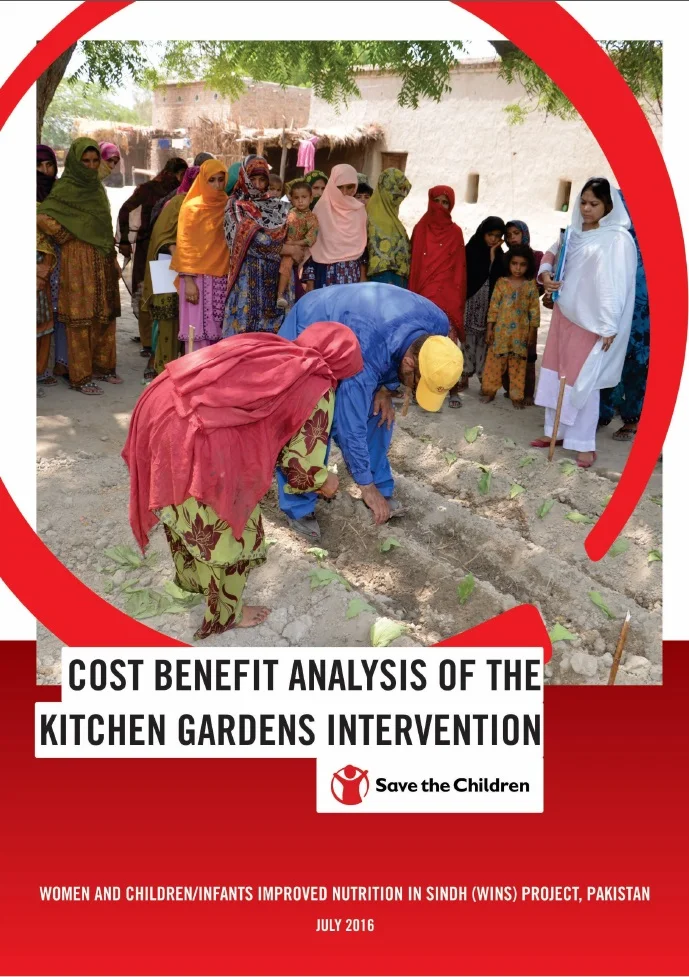
Cost Benefit Analysis of the Kitchen Gardens Intervention
REPORT
The kitchen gardens intervention is one of the nutrition-sensitive activities of the WINS project, intended to increase year-round access to nutritious foods, thereby bringing down the cost of a nutritious diet and increasing self-sufficiency and improving dietary diversity. This report presents a costs benefit analysis on the outcomes of the kitchen gardens intervention of the WINS project.
Women and Children/Infants Improved Nutrition in Sindh (WINS) Project, Pakistan
Women and Children/Infant Improved Nutrition in Sindh (WINS) is a four-year project, funded by the European Union (EU), with the overall objective of improving the nutrition status of children, pregnant and lactating women in three districts of the Sindh Province, Pakistan.
The kitchen gardens intervention is one of the nutrition-sensitive activities of the WINS project, intended to increase year-round access to nutritious foods, thereby bringing down the cost of a nutritious diet and increasing self-sufficiency and improving dietary diversity. This report presents a costs benefit analysis on the outcomes of the kitchen gardens intervention of the WINS project.

Fairness for Children: Inequalities in Rich Countries
Report
A new UNICEF report presents evidence on how inequality affects children in high-income countries.
The thirteenth edition of UNICEF’s Office of Research Report Card, Fairness for Children: A league table of inequality in child well-being in rich countries, presents an overview of the growing inequalities among children in high-income countries. It focuses on ‘bottom-end inequality’ – the gap between children at the bottom and those in the middle – in the context of income, education, health and life satisfaction. The report also provides recommendations for governments on strengthening child well-being.

Child poverty: What drives it and what it means for children
Report
New flagship report looks at the situation of children living in poverty in countries around the world shining a light on the drivers and its consequneces.
This new, flagship report looks at the situation of children living in poverty in countries around the world, shining a light on the drivers of child poverty and exploring why it persists, even in some of the wealthiest places. We also hear from children in poverty themselves: our best guides to understanding the urgency of this challenge.
This report is part of a concerted effort by Save the Children, together with partners in the Global Coalition to End Child Poverty, to ensure that the poorest children across the world receive the attention that they deserve. While there are great differences between societies, it is clear that fundamental similarities exist in the drivers and experiences of child poverty. The same is true of the essential solutions.
Dowload the report: [En] [Sp] [Fr] [Ar] ǀ Read the executive summary
Further resources: Global child poverty poster ǀ Global Webinar recording
About this Report


© 2016 Save the Children UK

How Inequalities Develop Through Childhood
DISCUSSION PAPER
This paper contributes longitudinal research evidence on the impact of structural inequalities on children’s development within households and communities, the ways access to health, education and other key services may reduce or amplify inequalities, and the ways that children’s developmental trajectories diverge from early in life through to early adulthood.
DISCUSSION PAPER
Life Course Evidence from a Young Lives Cohort Study
This paper contributes longitudinal research evidence on the impact of structural inequalities on children’s development within households and communities, the ways access to health, education and other key services may reduce or amplify inequalities, and the ways that children’s developmental trajectories diverge from early in life through to early adulthood.


Children of the Millennium
REPORT
Using data gathered from 12,000 children and their families over the timeframe of the MDGs, and in children’s own words where possible, this report from Young Lives looks beyond the ‘big data’ to see what has changed in the reality of children’s lives in the context of the shifts in national policy, priorities and outcomes related to the MDGs.
REPORT
Growing up with the MDG'S
Using data gathered from 12,000 children and their families over the timeframe of the MDGs, and in children’s own words where possible, this report from Young Lives looks beyond the ‘big data’ to see what has changed in the reality of children’s lives in the context of the shifts in national policy, priorities and outcomes related to the MDGs.


Child Poverty Indicators to Measure Progress on the SDGs
BRIEF
This policy brief provides recommendations to measure child poverty as part of the post-2015 development agenda.
BRIEF
The Coalition of Partners Working to End Child Poverty has developed a policy brief that assesses how child poverty can be included as part of the new monitoring framework of the SDGs (Sustainable Development Goals). The brief provides specific recommendations to support United Nations member states in framing their new poverty reduction indicators and ensure children are included and not let behind.
1. The current draft Post-2015 development goals and targets that include child poverty should include specific child poverty indicators
2. Efforts to monitor progress towards new SDG Targets 1.1 and 1.2 should include the following monetary and multidimensional poverty indicators:
-Percentage of population below $1.90 per day, disaggregated by age to capture the child poverty rate
-Proportion of children (0-17) below the national poverty line
-Proportion of children (0-17) living in multidimensional poverty
3. Child poverty targets should be reinforced with a new focus on equity to ensure the poorest and most disadvantaged children are reached and no child is left behind:
-All child-level indicators used in the SDGs should be disaggregated by income or wealth quintiles, ‘monetary’ and ‘multidimensional’ poverty status and other forms of inequality
4. Data collection for the most vulnerable children – who are often omitted from or bypassed in surveys and programmes – must be improved1. The current draft Post-2015 development goals and targets that include child poverty should include specific child poverty indicators


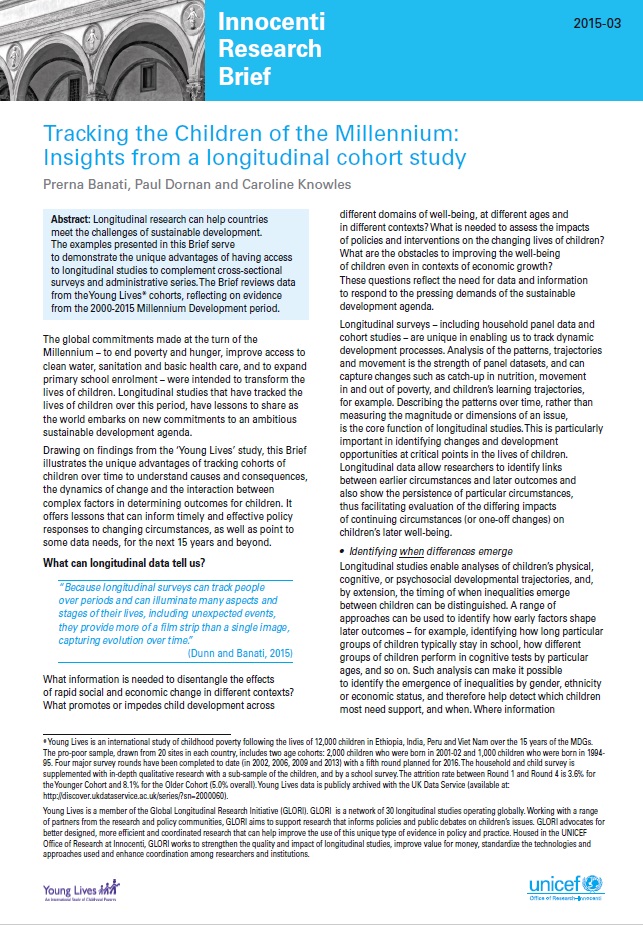
Tracking the Children of the Millennium
BRIEF
Drawing on findings from Young Lives, this Brief illustrates the unique advantages of tracking cohorts of children over time to understand causes and consequences, the dynamics of change and the interaction between complex factors in determining outcomes for children. It offers lessons that can inform timely and effective policy responses to changing circumstances, as well as point to some data needs, for the next 15 years and beyond.
BRIEF
Insights from a longitudinal Cohort Study
Drawing on findings from Young Lives, this Brief illustrates the unique advantages of tracking cohorts of children over time to understand causes and consequences, the dynamics of change and the interaction between complex factors in determining outcomes for children. It offers lessons that can inform timely and effective policy responses to changing circumstances, as well as point to some data needs, for the next 15 years and beyond.