Report
What Works to Reduce Child Poverty? Insights from Across the Globe
This report, developed by the Global Coalition to End Child Poverty, presents new multidimensional child poverty trend data and highlights countries that have made notable progress — Bangladesh, Cambodia, Indonesia, Peru, Poland, Senegal, and Tanzania. By distilling the key policies, programmes, and contextual drivers behind these gains, the report aims to provide practical advice for other countries and the international community.
What Works to Reduce Child Poverty? Insights from Across the Globe
Children experience poverty across multiple dimensions – whether deprived of shelter, food, water, education or health care. Growing up without these necessities is a violation of a child's rights, with consequences that can last a lifetime.
This report, developed by the Global Coalition to End Child Poverty, presents new multidimensional child poverty trend data and highlights countries that have made notable progress — Bangladesh, Cambodia, Indonesia, Peru, Poland, Senegal, and Tanzania. By distilling the key policies, programmes, and contextual drivers behind these gains, the report aims to provide practical advice for other countries and the international community.

Author: Global Coalition to End Child Poverty
Publication Date: May 2025
See also this summary blog post.

Policy Paper
CHILD POVERTY IN THE VOLUNTARY NATIONAL REVIEWS - A REVIEW OF VNR REPORTS FROM 2017 TO 2024
This Coalition brief will be the fifth analysis of the VNRs from a child poverty perspective, looking at how countries report on child poverty. This analysis builds upon the previous briefing paper developed by the Coalition, which reviewed VNRs from 2017 to 2022. This year’s analysis reviews both the 2023 and 2024 VNRs and provides reflections on the trends since 2017.
CHILD POVERTY IN THE VOLUNTARY NATIONAL REVIEWS - A REVIEW OF VNR REPORTS FROM 2017 TO 2024
To monitor and assess national progress on the SDGs, each year a select number of countries present their Voluntary National Reviews (VNRs) to the United Nations High-Level Political Forum on Sustainable Development (HLPF). This process enables countries to take stock of their achievements and challenges, share lessons learned and identify actions to accelerate the implementation of the 2030 Agenda. The VNRs are important as they are a key tool for accountability for the SDGs, both at the national and global level.
One way to assess progress on SDG implementation – including efforts to end child poverty - is to survey the data and narrative content that countries present in their VNRs. This Coalition brief is the fifth analysis of the VNRs from a child poverty perspective, looking at how countries report on child poverty. This analysis builds upon the previous briefing paper developed by the Coalition, which reviewed VNRs from 2017 to 2022. This brief reviews both the 2023 and 2024 VNRs and provides reflections on the trends since 2017.

Author: Global Coalition to End Child Poverty
Publication Date: April 2025
Download the Policy Brief.
Check also this ‘traffic light’ overview of how countries have reported on child poverty in their VNRs.
A Disproportionate Burden: Children in Poverty Bearing the Brunt of the Climate Crisis
Child Poverty and Climate Risks
The climate crisis is not a distant risk but is already threatening children’s rights and their well-being here and now. Almost every child in the world is exposed to major climate and environmental hazards, and 4 out of 5 children face at least one extreme climate event per year. Also, children born today face much higher climate risks than those from previous generations, as the growing concentration of greenhouse gases in the atmosphere lead to more frequent and intense extreme weather events.
The climate crisis is not a distant risk but is already threatening children’s rights and their well-being here and now. Almost every child in the world is exposed to major climate and environmental hazards, and 4 out of 5 children face at least one extreme climate event per year. Also, children born today face much higher climate risks than those from previous generations, as the growing concentration of greenhouse gases in the atmosphere lead to more frequent and intense extreme weather events.
This report aims to answer the following questions:
1. Are children living in poverty more exposed to climate shocks?
2. Are children living in poverty more vulnerable to the impacts of climate shocks?
3. Do climate shocks increase child poverty?
4. What policies and programmes can address the impacts of climate shocks on children and their families living in poverty or those vulnerable to poverty?

Author/s: Global Coalition to End Child Poverty
Publication Date: December 2023
Download the full paper and the summary.
Joint Statement
A CALL TO ACTION TO EXPAND SOCIAL PROTECTION AND CARE SYSTEMS AND PROMOTE DECENT WORK TO ADDRESS CHILD POVERTY
On the International Day for Eradication of Poverty, and on every day, the Global Coalition to End Child Poverty calls on Governments, businesses and the International Community to:
Expand access to inclusive social protection, including child benefits
Promote inclusive childcare and parental support systems, inlcuding parental leave and affordable, accessible and quality childcare services
Promote a decent work agenda
A Call to Action to expand social protection and care systems and promote decent work to address child poverty
A staggering 333 million children live in extreme poverty, struggling to survive on less than $2.15 per day, and more than 800 million children subsist below a poverty line of $3.65 per day. Beyond income metrics of poverty[1], half of the 1.1. billion people experiencing multidimensional poverty (MPI) are children even if their share of the global population is only around 30 percent[2]. Approximately one billion children are deprived of their basic rights and needs in areas such as health, nutrition, education, water, sanitation and housing[3].
Two critical policy levers for tackling, reducing and ending child poverty are i) the expansion of inclusive social protection, including child benefits and paid parental leave, and ii) enabling access to decent work for adults who bear responsibility to provide for children in their household. It is therefore timely that the theme of the International Day for the Eradication of Poverty for 2023 touches upon these key points, namely: ‘Decent Work and Social Protection – Putting Dignity in Practice’.
On the International Day for Eradication of Poverty, and on every day, the Global Coalition to End Child Poverty calls on Governments, businesses and the International Community to:
Expand access to inclusive social protection, including child benefits.
Promote inclusive childcare and parental support systems, including paid parental leave and accessible and quality childcare for children and families in poverty.
Promote a decent work agenda, including ensuring every worker has access to social protection and adequate living wages, and young people receive relevant education and training opportunities.

Title:
A Call to Action to expand social protection and care systems and promote decent work to address child poverty
Author/s: Global Coalition to End Child Poverty
Publication date: October 2023
Download here
Briefing Paper
CHILD POVERTY IN THE VOLUNTARY NATIONAL REVIEWS - A REVIEW OF VNR REPORTS FROM 2017 TO 2024
This Coalition brief will be the fifth analysis of the VNRs from a child poverty perspective, looking at how countries report on child poverty. This analysis builds upon the previous briefing paper developed by the Coalition, which reviewed VNRs from 2017 to 2022. This year’s analysis reviews both the 2023 and 2024 VNRs and provides reflections on the trends since 2017.
Are countries committed to ending child poverty by 2030? A review of VNR reports from 2017 to 2022
Ending poverty in all its forms for everyone, including for children – is at the heart of the 2030 Agenda for Sustainable Development (2030 Agenda) and the Sustainable Development Goals (SDGs), adopted in 2015 by the Member States of the United Nations. Through SDG 1, the 2030 Agenda provides a clear framework or action: Countries must eradicate extreme poverty for all people – including children - by 2030 as internationally defined (PPP $1.90) and reduce at least by half the proportion of children living in poverty in all its dimensions according to national definitions.
The combined crises comprising the climate emergency, the COVID-19 pandemic, and increased conflicts, food prices and inflation, highlight that urgent action is needed to halt worsening outcomes for children. For example, it is estimated that it will take at least seven to eight years to recover and return to pre-COVID-19 levels of monetary child poverty. In addition, many other child-focused outcomes, such as educational attainment, immunization, reduced hunger, and improved nutrition continue to be at risk of drastically worsening. There are clear indications that the world will fall short in achieving the 2030 Agenda´s aim to end extreme child poverty and at least halve multidimensional child poverty.
To monitor and assess national progress on the SDGs, each year a select number of countries present their Voluntary National Reviews (VNRs) to the United Nations High-Level Political Forum on Sustainable Development (HLPF). This process enables countries to take stock of their achievements and challenges, share lessons learned and identify actions to accelerate the implementation of the 2030 Agenda. The VNRs are important as they are a key tool for accountability for the SDGs, both at the national and global level.
One way to assess progress on SDG implementation – including efforts to end child poverty - is to survey the data and narrative content that countries present in their VNRs. This Coalition brief is the fourth annual analysis of the VNRs from a child poverty perspective, looking at how countries address and discuss their efforts to end child poverty, through both measurement and policies. This analysis builds upon the 2021 briefing paper developed by the Coalition, which reviewed VNRs from 2017 to 2021. This year’s analysis reviews the 2022 VNRs and provides reflections on the trends since 2017.
Title: Are countries committed to ending child poverty by 2030? A review of VNR reports from 2017 to 2022
Author/s: Global Coalition to End Child Poverty
Publication date: February 2023
Download the full briefing paper and the summary.
Check also this ‘traffic light’ overview of how countries have reported on child poverty in their VNRs.
Briefing Paper
ENDING CHILD POVERTY: A POLICY AGENDA
This brief highlights the urgency of tackling child poverty and the growing vulnerability of many children around the world due to the COVID-19 pandemic, climate crisis, conflict, and economic instability.
Ending Child Poverty: A Policy Agenda
This brief highlights the urgency of tackling child poverty and the growing vulnerability of many children around the world due to the COVID-19 pandemic, climate crisis, conflict, and economic instability. The brief reviews the latest data regarding child poverty and highlights best practices in tackling child poverty.
It draws on evidence and the experience of over 20 organizations working together in the Global Coalition to End Child Poverty.
It outlines key building blocks for how countries can address child poverty and offers evidence and experience to support national discussion on the best policy options for children.
Build national support by ensuring that reducing child poverty is an explicit national priority.
Expand child-sensitive social protection
Improve access to quality public services, especially for the poorest children.
Promote decent work and inclusive growth agenda to reach families and children in poverty.
The building blocks are discussed as an entry point to identify the types of policies that can help overcome child poverty and its impacts.

Title: Ending Child Poverty: A Policy Agenda
Author/s: Global Coalition to End Child Poverty
Publication date: October 2022
Download the policy brief.
Briefing Paper
ARE COUNTRIES COMMITTED TO ENDING CHILD POVERTY BY 2030?
This Coalition brief is the third annual analysis of the VNRs from a child poverty perspective, looking at how countries mention and discuss their efforts to end child poverty, through measurement and policies. This analysis builds upon last year’s brief developed by the Coalition, which reviewed VNRs from 2017 to 2020.
Are countries committed to ending child poverty by 2030? A review of VNR reports from 2017 to 2021
Ending poverty in all its forms for everyone, including for children – is at the heart of the Sustainable Development Goals, adopted in 2015 by the global community. The SDG Agenda provides a clear framework for action: Countries must eradicate extreme child poverty by 2030 as internationally defined (PPP $1.90) and halve the number of children living in poverty in all its dimensions according to national definitions.
2021 marked the opening of the Decade of Action to accelerate solutions to achieve these ambitious goals. However, the COVID-19 crisis has impacted progress in the reduction of child poverty (approximately 150 million additional children were pushed into multidimensional poverty by the end of 2020[1]), bringing to light the urgency for governments to adopt long-term policy and programmatic actions to reduce child poverty.
Governments must take concerted actions to prevent this pandemic from turning into a child poverty crisis, through strengthening social protection systems and social services.
To monitor and assess their progress on the SDGs, each year a select number of countries present their Voluntary National Reviews (VNRs) to the UN High-Level Political Forum (HLPF). This process enables countries to take stock of their achievements and challenges, share lessons learned and identify actions to accelerate implementation of the 2030 Agenda.
One way to gauge progress on SDG implementation is to survey the data and the narrative content that countries present in their VNRs. This Coalition brief is the third annual analysis of the VNRs from a child poverty perspective, looking at how countries mention and discuss their efforts to end child poverty, through measurement and policies. This analysis builds upon last year’s brief[1] developed by the Coalition, which reviewed VNRs from 2017 to 2020. This year’s analysis is based on the 2021 VNRs.

Title: Are countries committed to ending child poverty by 2030? A review of VNR reports from 2017 to 2021
Author/s: Global Coalition to End Child Poverty
Publication date: October 2021
Download the briefing note and the three-pager.
[1] http://www.endchildhoodpoverty.org/publications-feed/2020/10/17/briefing-paper
Briefing Paper
Child Poverty: A Call to Tackle its Persistence
This brief from the Global Coalition to End Child Poverty looks at the drivers of intergenerational persistent poverty and how it can lead to disempowerment, discrimination and stigma, which feed the vicious circle of poverty and exclusion.
Child Poverty: A Call to Tackle its Persistence
Before the Covid-19 pandemic hit, 689 million people across the world were living in extreme poverty and 1.3 billion in multidimensional poverty. Children are disproportionately impacted by poverty; they are twice as likely as adults to be living in extreme and multidimensional poverty and the impact of the global pandemic is to exacerbate this situation. This brief from the Global Coalition to End Child Poverty looks at the drivers of intergenerational persistent poverty and how it can lead to disempowerment, discrimination and stigma, which feed the vicious circle of poverty and exclusion. It shows why tackling the intergenerational persistence of extreme poverty is essential if we are to achieve SDG 1 and ‘build back better’ without leaving behind the most vulnerable children. Doing so requires a focus on both individuals and structural and institutional barriers, and starts with a shift in language.
Key messages:
1. Many of the documents on intergenerational poverty use the term ‘transmission of poverty’. This carries the unfortunate connotation that poverty is a form of social illness that is transmitted from one person to the next - potentially further adding to stigma and mistreatment. Instead, we call for using the term ‘persistence of poverty’, for it implies many other levels of responsibility, including those of governments, in addition to those of parents.
2. With Covid-19 causing many more to fall into extreme poverty, we call for maintaining a focus on those living in chronic poverty.
3. We need greater acknowledgement that poverty, including child poverty, is a deliberate policy choice. Institutional and structural barriers can maintain families in a state of deep and chronic poverty. We argue that tackling extreme poverty requires challenging this status quo.
4. To reverse the current trend and eliminate the persistence of poverty, we need investments in social protection systems providing children and their caregivers with income support and links to other services which can be critical in meeting children’s basic needs and allowing families in poverty to lead a life of dignity. In addition, strong emotional support systems for children are needed as well as policies combating stigmatization, fostering social cohesion and integration.

Title: Child Poverty: A Call to Tackle its Persistence
Author/s: Global Coalition to End Child Poverty
Publication date: July 2021
Briefing paper
ARE COUNTRIES COMMITTED TO ENDING CHILD POVERTY BY 2030?
This Coalition brief is the second annual analysis of the VNRs from a child poverty perspective, looking at how countries mention and discuss their efforts to end child poverty, through measurement and policies.
Are countries committed to ending child poverty by 2030? A review of VNR reports from 2017 to 2020
Ending poverty in all its forms for everyone, including for children, is at the heart of the Sustainable Development Goals, adopted five years ago by the global community. The SDG Agenda provides a clear framework for action: Countries must eradicate extreme child poverty by 2030 as internationally defined (PPP $1.90) and halve the number of children living in poverty in all its dimensions according to national definitions.
One way to gauge progress on SDG implementation is to survey the data and the narrative content that countries present in their Voluntary National Reviews (VNRs).
This Coalition brief is the second annual analysis of the VNRs from a child poverty perspective, looking at how countries mention and discuss their efforts to end child poverty, through measurement and policies. This analysis builds upon last year’s brief developed by the Coalition, which reviewed VNRs from 2017, 2018, and 2019.
Title: Are countries committed to ending child poverty by 2030? A review of VNR reports from 2017 to 2020
Author/s: Global Coalition to End Child Poverty
Publication date: October 2020
Download the briefing note and two pager
Joint statement
Expanding children’s access to Child-Sensitive Social Protection in the wake of COVID-19
A Call to Action for governments to maintain and scale up their investments in child-focused and child-sensitive social protection to avoid failing an entire future generation.
A Call to Action for governments to expand children’s access to Child-Sensitive Social Protection in the wake of COVID-19
COVID-19 threatens to push millions more children into poverty and deprivation across the world, risking lasting negative impacts on them and wider society. While governments have been putting in place short-term social protection measures to protect their citizens from the immediate economic impacts of the pandemic, this Call to Action explains why governments must maintain and scale up their investments in child-focused and child-sensitive social protection to avoid failing an entire future generation.

Title:
A Call to Action for governments to expand children’s access to Child-Sensitive Social Protection in the wake of COVID-19
Author/s: Global Coalition to End Child Poverty
Publication date: August 2020
Download HERE
Briefing paper
ARE COUNTRIES COMMITTED TO ENDING CHILD POVERTY BY 2030?
This Coalition brief focuses on how children living in poverty are reflected in the SDG Voluntary National Reviews (VNR), based on content analysis of VNR reports from 2017, 2018 and 2019 – with a specific focus on the latest July 2019 HLPF.
Voluntary National Reviews for the Sustainable Development Goals: Are countries committed to ending child poverty by 2030?
For the first time in history, nations have agreed to end extreme child poverty (children living on less than $1.90/day) by 2030, as part of the global Sustainable Development Goals (SDG) - and to halve child poverty as nationally defined. 2019 marks the fourth year of the SDGs – we have eleven years remaining to achieve these ambitious, but absolutely attainable child poverty targets of SDG 1.
However, the global and national efforts required to achieve SDG 1 are significant. Children bear the greatest brunt of poverty: as of 2016 there were 385 million children struggling to survive on less than $1.90/day and as of 2019, there were 663 million children living in multidimensionally poor households.
The 2030 Agenda asks member states to conduct regular and inclusive reviews of progress at the national and sub-national levels, and these should be country-led and country-driven. These Voluntary National Reviews (VNRs) have been presented annually at the United Nations High-Level Political Forum, enabling countries to report their progress on the SDGs as well as share information with other countries.
This Coalition brief focuses on how children living in poverty are reflected in the VNRs, based on content analysis of VNR reports from 2017, 2018 and 2019 – with a specific focus on the latest July 2019 HLPF.

Title: Voluntary National Reviews for the Sustainable Development Goals: Are countries committed to ending child poverty by 2030?
Author/s: Global Coalition to End Child Poverty
Publication date: October 2019
Download HERE
Briefing paper
Child poverty measurement and monitoring: The missing children
This brief explores certain groups of poor children potentially missing from data or from analysis, with particular attention to the policy and programming implications for poverty reduction.
CHILD POVERTY MEASUREMENT AND MONITORING: THE MISSING CHILDREN
A key focus of the Sustainable Development Goals (SDGs) is leaving no one behind, which includes a call for increased efforts and innovations to count all children living in poverty, in all its forms (monetary and multidimensional).
National household surveys are the most commonly used and reliable sources of data to estimate poverty. These surveys have led to increasingly better and more frequent information on the situation of households and individuals living in poverty and, in most countries, they provide the critical data to set baselines for SDG poverty targets.
However, there are certain groups of children living in poverty that are not reflected in these poverty statistics. These include:
Children not living in households
Poor children living in households which are not captured in household survey sample frameworks
Poor children living in households but the household survey data analysis/methods applied do not sufficiently reflect their situation.
These distinct groups of poor children potentially missing from data or from analysis are explored in this brief from the Global Coalition to End Child Poverty, with particular attention to the policy and programming implications for poverty reduction, as well as the implications of setting SDG poverty-related baselines and targets where certain groups of children may be missing from these baselines.
The brief also outlines prominent and innovative approaches to better capture children currently missing from or not sufficiently reflected in data, and highlights efforts supported by the Global Coalition to End Child Poverty, so that groups of children living in poverty but not represented in national poverty statistics can benefit from the focus and progress that the SDGs will bring.

Title: Child poverty measurement and monitoring: The missing children
Author/s: Global Coalition to End Child Poverty
Publication date: July 2019
Download HERE
Briefing Paper
Child Poverty and Adolescent Transitions
This brief shows why reducing poverty during the second decade of a child’s life is necessary to promote children’s rights and is a sound investment for the future. It identifies actions that governments and others can take, and the data and evidence gaps that need to be addressed in order to tackle adolescent poverty and its consequences.
Child Poverty and Adolescent Transitions
This brief from the Global Coalition to End Child Poverty is intended as a tool for governments and their partners. It shows why reducing poverty during the second decade of a child’s life is necessary to promote children’s rights and is a sound investment for the future. It identifies actions that governments and others can take, and the data and evidence gaps that need to be addressed in order to tackle adolescent poverty and its consequences.
Why focus on poverty during adolescence?
Tackling poverty during children’s early years is essential, but adolescence offers another crucial window of opportunity to mitigate the impact of poverty on children’s development, to build on investments in the early years, and to promote gender equality and social mobility for all young people so that the whole of society benefits.
Key Messages:
- Effective policies and services during adolescence have the potential to generate what the Lancet Commission on Adolescent Health and Well-Being calls a ‘triple dividend’ – improving adolescents’ lives now, into adulthood, and for the next generation of children.
- High-quality, multi-dimensional and disaggregated data from adolescents underpins good policy and programming, contributes to strategies to tackle gender and other inequalities, and supports the monitoring of progress against the Sustainable Development Goals.
- Adolescence is a time when gender and other inequalities can deepen. Supporting adolescents living in poverty requires coherent, cross-sectoral policies, investments in adolescent-responsive services, effective platforms for adolescent engagement, and attention to the rights and needs of girls and boys.
- The brief highlights how effective interventions can support disadvantaged adolescents’ health and well-being, education and learning, protection from harm, economic opportunities, participation and engagement, and social protection. Scaling-up and financing programmes, and achieving sustainable benefits for disadvantaged adolescents are key challenges. Building wider economic and social opportunities for young people is an important complement to targeted interventions.

Title; Child Poverty and Adolescent Transitions
Author/s; Global Coalition to End Child Poverty
Publication Date; December 2017
Download HERE
Briefing Paper
Child-sensitive Social Protection
This policy brief from the Global Coalition to End Child Poverty defines the principles of Child-sensitive Social Protection (CSSP), why it is crucial for helping ensure the well being and realisation of rights for children, and broadly summarises how the coalition and its partners can help achieve CSSP.
Child Sensitive Social Protection
Child-sensitive Social Protection (CSSP) is a well-proven approach within social protection to help realize the rights of children. CSSP helps families to cope with chronic poverty, stresses and shocks and enables them to invest on an adequate and continuing basis in their children’s well-being. CSSP can be implemented in both humanitarian and development contexts, and across sectoral areas, to advance the rights and wellbeing of children, including – particularly - those who are poorest and most deprived. This involves designing and implementing specific polices and programmes that directly address children's needs and rights and improve child development, as well as more widely ensuring that all social protection programmes are child-sensitive, by planning to maximise beneficial impacts and minimise any potential harms fro children, girls and boys alike.
Why social protection needs to be child-sensitive...
Fully half of the world’s people who live in extreme poverty are children, and their experience of poverty and vulnerability and social exclusion is different from that of adults. Small differences in the design and implementation of social protection programmes can make a huge difference for children. Making social protection child-sensitive has the potential to benefit not only children, but also their families, communities and national development as a whole.
This policy brief from the Global Coalition to End Child Poverty defines the principles of CSSP and broadly summarises;
- How is Child-sensitive Social Protection pursued and implemented
- Social protection and priority sectors for the life cycle of children
- How can CSSP be achieved
- The role of the coalition and its partners' in helping to advance CSSP

Title; Child Sensitive Social Protection Briefing Paper
Author/s; Global Coalition to End Child Poverty
Publication date; 1/11/2017
Download HERE

SDG Guide on Child Poverty
A world free from child poverty: A guide to the tasks to achieve the vision
The new guide is an attempt to harness our knowledge and experience to support national processes to achieve the new SDG goals on child poverty.
A world free from child poverty: A guide to the tasks to achieve the vision
A world in which no child grows up in poverty and every child can fulfil their potential would be a different world indeed. This is why we see ending child poverty as a defining challenge of human progress.
While there have been many positive changes in recent decades, the challenges for children remain significant: children are significantly more likely to live in poverty than adults, and the impact of poverty on children can be devastating and lifelong, with implications for future generations and society as a whole. Furthermore, children face these challenges globally, in richer and poorer countries alike.
Crucially, although perhaps less recognized, there are specific solutions to address child poverty. These range from direct transfers and benefits that reach families with children living in poverty, to ensuring real access to quality services for all, to addressing the stigma and discrimination that can block children’s hope and potential, not least – and perhaps most cruelly – in their own minds.
Despite this, in many countries, child poverty is not explicitly targeted as a national priority, and it is often not routinely measured or reported on. Two years ago, a diverse group of organizations came together to form a Global Coalition to End Child Poverty to work collectively for change.
A world free from child poverty: A guide to the tasks to achieve the vision is an attempt to harness our knowledge and experience to support national processes to achieve Sustainable Development Goal (SDG) 1 on Ending Poverty, which includes children explicitly for the first time in global poverty goals and, in doing so, support all the SDGs which are so crucial to the realization of children’s rights.

Download the guide by milestone
To recognize the importance of having a clear sense of intention around child poverty work, the Guide suggests – and is organized by – an indicative set of Milestones to guide work. It is important to stress in reality countries will start from different places and will follow different paths, the indicative Milestones to organize the guide are:
Milestone 1: Building a national pathway to end child poverty
A number of countries are not currently prioritizing child poverty and not producing national child poverty measures. Convening stakeholders to share information about child poverty and its responses can be an important step in understanding how, and indeed if, to move forward, and what a national pathway to achieving the SDGs on child poverty may look like.
Milestone 2: Measuring child poverty
Routine national measurement of child poverty is central. Without knowing how many and which children are living in multidimensional and monetary poverty, we cannot know how we are progressing to the goal, or the impacts of particular policies and programmes on child poverty. Technically measuring child poverty is not difficult, yet there can be a number of options that can confuse, and it does require some particular statistical expertise.
Milestone 3: Putting child poverty on the map: child poverty advocacy
Child poverty has been shown in many contexts to resonate with both the public and decision makers as a priority issue. Broad child poverty advocacy and communication of the results of child poverty measurement can raise the issue up national political agendas, as well as raise awareness in specific and influential audience groups. Crucially, it can begin the conversation on policy and programmatic solutions.
Milestone 4: Reducing child poverty through policy and programme change
To reduce child poverty requires appropriate policies and programmes to be initiated or expanded. There are a clear set of approaches – ranging from cash transfer programmes to improving access and quality of education for the poorest children – that can make a difference. To make these changes requires clarity on which approaches are needed for the particular national context, and a combination of advocacy and technical analysis to support policy makers in forging change.
Milestone 5: Achieving the SDGs: ending extreme child poverty and halving it by national definitions
For some countries, the final step may be integrating child poverty into a poverty reduction plan that fully considers children, or a child-specific national action plan. This can bring together the situation of child poverty with integrated policy and programmatic solutions. Crucially, the implementation of these plans should be monitored and evaluated.
Briefing Paper
Putting Children First: A Policy Agenda to End Child Poverty
This briefing paper draws on evidence and the experience of over 20 organisations working together in the Global Coalition to End Child Poverty.
It outlines key building blocks for how countries can address child poverty and offers evidence and experience to support national discussion on the best policy options for children.
Putting Children First: A Policy Agenda to End Child Poverty
This briefing paper draws on evidence and the experience of over 20 organisations working together in the Global Coalition to End Child Poverty.
It outlines key building blocks for how countries can address child poverty and offers evidence and experience to support national discussion on the best policy options for children.
- Build national support by ensuring that reducing child poverty is an explicit national priority.
- Expand child-sensitivity in social protection systems and programmes.
- Improve access to quality public services, especially for the poorest children.
- Promote a decent work and inclusive growth agenda to reach families and children in poverty.
The building blocks are discussed as an entry point to identify the types of policies that can help overcome child poverty and its impacts.

Joint Statement
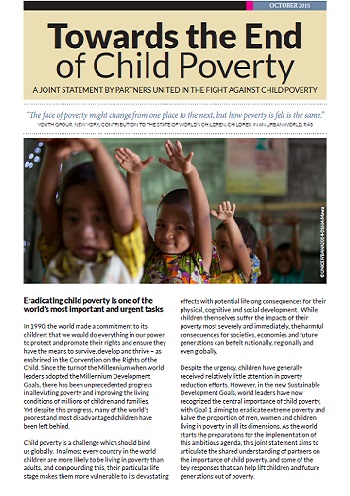
Towards the End of Child Poverty: Joint Statement
This joint statement aims to articulate the shared understanding of the importance of child poverty, its devastating consequences, and the key responses that can help lift children and future generations out of poverty as we usher in the era of the Sustainable Development Goals (SDGs).
Towards the End of Child Poverty: Joint Statement
This joint statement aims to articulate the shared understanding of the importance of child poverty, its devastating consequences, and the key responses that can help lift children and future generations out of poverty as we usher in the era of the Sustainable Development Goals (SDGs).
Key messages include
1. Children are key to ending poverty: Today’s children are central to ending poverty and promoting a more sustainable, equitable, just future.
2. Despite substantial progress in reducing global poverty, children continue to bear a burden. Nearly 1 in 2 extremely poor persons around the world is 18 years old or younger. Beyond financial poverty, many children suffer from deprivations related to nutrition, health, education, water, and sanitation.
3. The new SDGs aim to tackle child poverty by halving the proportion of men, women and children living in poverty in all its dimensions (Target 1.2) by 2030.
4. Country experiences show that progress is possible by prioritizing efforts to reduce child poverty, expanding child-sensitive social protection systems and programs, improving access to quality public services-especially for the poorest children-and promoting inclusive growth.